
Bay of Fundy in New Brunswick: What to See, Where to Go & How to Plan Your Visit

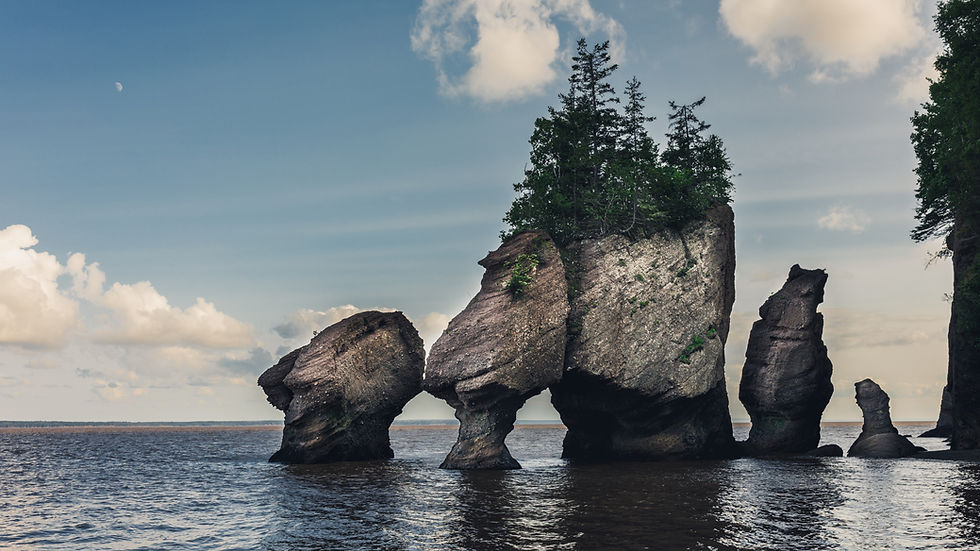
There is a moment at Hopewell Rocks when you realize the landscape in front of you isn't staying the same. At low tide, the enormous sandstone formations rise above you.
Their tree-covered tops seem almost too tall to have been carved by the sea.
Then the water begins returning. Hours later, the perspective has completely changed.
The rocks that stood beside you on the ocean floor are now surrounded by water.
That transformation is the reason the Bay of Fundy in New Brunswick deserves more than a quick stop on an Atlantic Canada road trip. And Hopewell Rocks is only the beginning.
The New Brunswick side of Fundy stretches through coastal communities, parks, cliffs, beaches, sea caves, forests and scenic roads. You can walk on the ocean floor.
You can hike through coastal forest. You can drive along spectacular viewpoints.
You can explore sea caves near St. Martins. Or you can simply pull over somewhere along the coast, look toward the bay and watch the landscape do what it has been doing for thousands of years. The challenge isn't finding something to see.
It's deciding what deserves your time.
What makes the Bay of Fundy in New Brunswick special?
The Bay of Fundy is shared by New Brunswick and Nova Scotia, but the visitor experience isn't identical on both sides.
In New Brunswick, one of the most recognizable expressions of the tides is found at Hopewell Rocks Provincial Park.
Tourism New Brunswick describes the area as one of the province's top destinations, where erosion over thousands of years has created distinctive sandstone formations known as the Flowerpot Rocks. At low tide, visitors can walk along the ocean floor and explore coves; at high tide, kayaking offers a completely different perspective.
But the New Brunswick Fundy coast extends far beyond Hopewell Rocks.
The broader region includes:
Hopewell Rocks
Fundy National Park
Fundy Trail Provincial Park
St. Martins
Fundy coastal viewpoints
Sea caves
Saint John
Coastal communities
Whale-watching opportunities
Scenic road-trip routes
Tidal experiences around the bay
Tourism New Brunswick also promotes the region through coastal road trips, parks, wildlife, lighthouses and seafood experiences.
So if you're planning a trip here, don't think of Hopewell Rocks as the entire Bay of Fundy.
Think of it as one particularly memorable chapter.
How dramatic are the Bay of Fundy tides in New Brunswick?
The numbers are impressive, but seeing the effect is more meaningful than memorizing them.
Tourism New Brunswick states that tides in the Bay of Fundy can rise by as much as 16 metres (52.5 feet), with approximately 160 billion tonnes of seawater moving into and out of the bay twice daily.
At Hopewell Rocks, the tides have spent thousands of years shaping sandstone cliffs into the distinctive formations visitors see today.
This creates two very different experiences.
At low tide
You can walk on the ocean floor around the Flowerpot Rocks and explore the shoreline.
At high tide
The same formations are surrounded by water, and kayaking can bring you almost level with the rock formations.
Hopewell Rocks: the place most visitors picture first
If someone mentions the Bay of Fundy in New Brunswick, Hopewell Rocks is probably the first destination that comes to mind. And there is a reason. The Flowerpot Rocks are instantly recognizable. Sandstone formations rise from the shoreline, their upper surfaces covered by trees and vegetation.
Over thousands of years, the interaction between water, rock and erosion has created the shapes visitors see today.
At low tide, the experience is remarkably different from a conventional coastal walk.
Instead of standing at the edge of the sea, you're down on the ocean floor. The rock formations tower above you.
Coves open up along the shoreline. And the tide that will eventually cover the area again is temporarily somewhere else. Tourism New Brunswick recommends checking tide schedules before visiting and allowing enough time to experience the park properly.
That advice is worth taking seriously. Your arrival time can change the entire experience.
What can you do at Hopewell Rocks?
There are several ways to experience the park.
Walk the ocean floor
This is the classic low-tide experience.
Tourism New Brunswick notes that visitors can explore approximately two kilometres of beach and several coves during suitable low-tide conditions.
Explore the viewpoints
If walking on the ocean floor isn't suitable for everyone in your group, the park also has walking trails and viewing areas.
Learn about the geology
The visitor facilities include interpretive information about the landscape and its formation.
Experience the rocks from the water
At high tide, guided kayaking experiences can provide an entirely different perspective on the Flowerpot Rocks. Tourism New Brunswick highlights kayaking as one of the ways to experience the formations when the water has returned.
If time allows, seeing the same rocks at different stages of the tide can be far more memorable than simply arriving for a single photograph.
A Local's Secret: don't stop at the obvious viewpoint
Hopewell Rocks is famous.
That also means many visitors naturally concentrate around the most recognizable formations.
But Tourism New Brunswick highlights Demoiselles Beach as a quieter area within the park, reached by a trail beyond the main visitor experience.
This is the sort of detail that can change how you experience a busy attraction.
Instead of treating the Flowerpot Rocks as the only reason to visit, give yourself time to explore beyond the first viewpoint.
If you're comfortable walking and your schedule allows, the additional trail can provide another perspective on the Fundy landscape.
The important point is simple:
Don't judge the entire park from the first ten minutes.
How should you plan around the Hopewell Rocks tides?
This is probably the most important practical question in the entire article.
Don't choose your Hopewell Rocks visit based only on your road-trip schedule.
Choose it around the tide schedule. Tourism New Brunswick specifically recommends checking the tide schedules before visiting.
Why? Because the experience changes dramatically.
Arrive during an appropriate low-tide window and you can walk the ocean floor.
Arrive when the formations are surrounded by water and your experience becomes primarily one of viewing the landscape from above or experiencing it from the water through an appropriate activity.
The exact tide time varies by date and location. So don't copy a tide time from an old blog post.
Check the official tide information for the date of your visit.
And always allow a safety margin rather than trying to squeeze every last minute out of a low-tide window.
Fundy National Park: when the forest becomes part of the Fundy experience
Hopewell Rocks is about seeing the power of the tide.
Fundy National Park gives you another perspective.
Here, the coastline meets Acadian forest, trails, lakes and wide-open natural spaces.
Tourism New Brunswick describes Fundy National Park as New Brunswick's first national park, established in 1948, with more than 120 kilometres of walking and hiking trails. It is open year-round, although individual activities and facilities can vary by season.
This makes Fundy National Park particularly useful for travelers who don't want their entire Fundy experience to revolve around one coastal attraction.
You can hike.
You can explore the forest.
You can spend time around Bennett Lake.
You can experience interpretive programs during the appropriate season.
And, of course, you can continue exploring the relationship between the land and the Bay of Fundy.
How much time do you need at Fundy National Park?
This depends on what you want to do.
A traveler who simply wants to see the landscape and a few viewpoints needs a very different schedule from someone planning a longer hike.
That's why I wouldn't recommend trying to combine every major Fundy attraction into one tightly packed itinerary.
Tourism New Brunswick lists more than 120 kilometres of trails within the park.
That's not a quick roadside stop.
If hiking is important to you, give the park its own time.
If your main goal is Hopewell Rocks, you may prefer a shorter Fundy National Park visit
combined with another nearby coastal experience.
The right itinerary depends on what you actually enjoy doing.
Fundy Trail Provincial Park: the road trip becomes the attraction
There are road trips where the destination is everything.
Then there are roads where you keep finding yourself pulling over.
The Fundy Trail Provincial Park is much closer to the second kind.
Tourism New Brunswick describes the park as a 2,559-hectare coastal park with a 30-kilometre scenic drive, waterfalls, beaches, hiking and biking trails, and more than 20 lookouts.
This is one of the strongest choices for travelers who enjoy scenery but don't necessarily want every stop to be a major tourist attraction.
You can drive.
You can hike.
You can stop at viewpoints.
You can walk toward the coast.
You can spend time simply looking.
The road itself becomes part of the experience.
St. Martins: another side of the Fundy coast
If Hopewell Rocks shows you what the tides do to sandstone formations, St. Martins introduces another side of the Fundy coastline.
The area is known for its coastal scenery and sea caves, and it connects naturally with the Fundy Trail region.
Tourism New Brunswick identifies St. Martins as one of the destinations along its Fundy Coastal Drive and highlights the area's sea caves and coastal experiences.
This makes St. Martins particularly interesting for travelers who want to turn their Fundy visit into a broader coastal journey.
Instead of:
Halifax → Hopewell Rocks → photograph → leave
you can think in terms of:
Coast → rock formations → forest → sea caves → viewpoints → coastal communities.
That is a much better way to understand the New Brunswick side of Fundy.
The Fundy Coast is made for a road trip
Tourism New Brunswick describes its Fundy Coast Road Trip as a roughly 330-kilometre, 7–10 day experience, while the broader Fundy Coastal Drive covers an approximately 460-kilometre route.
Those figures tell you something important.
The Fundy coast is not designed to be completely “done” in a few hours.
You can certainly visit one attraction as a day trip.
But if you want to experience several sections of the coast, the trip naturally becomes a road-trip experience.
A longer route can include combinations of:
Hopewell Rocks
Fundy National Park
Fundy Trail Provincial Park
St. Martins
Saint John
Coastal viewpoints
Fishing communities
Wildlife experiences
Local food
Scenic roads
The exact route should depend on how many days you have.
What if you only have one day?
This is where planning matters. If you have only one day, don't attempt the entire New Brunswick Fundy coastline. Choose one experience as your priority.
If your priority is the tides
Focus on Hopewell Rocks and build the day around the tide schedule.
If your priority is hiking
Give more time to Fundy National Park or Fundy Trail.
If your priority is coastal photography
Choose a route with multiple viewpoints and allow time to stop.
If you want a little of everything
Select two or three complementary experiences rather than six unrelated stops.
The biggest mistake on an Atlantic Canada road trip is often not choosing too few places. It's choosing too many.
Can you visit the Bay of Fundy in New Brunswick from Nova Scotia?
Yes, but your starting point and final destination matter.
New Brunswick's Fundy coast can form part of a broader Atlantic Canada itinerary connecting Nova Scotia and New Brunswick.
Tourism New Brunswick specifically presents the Fundy Coastal Drive as accessible to travelers arriving from Nova Scotia or Prince Edward Island via major routes.
For a traveler beginning in Halifax, the practical question is therefore not simply:
“Can I get to New Brunswick?”
It is:
“Which New Brunswick Fundy experience fits my overall Atlantic Canada route?”
If you're already planning time in Halifax, Peggy's Cove, Lunenburg or other Nova Scotia destinations, adding New Brunswick requires looking carefully at driving time and overnight arrangements.
That is where a multi-day private itinerary can make more sense than trying to force everything into one day.
Is Hopewell Rocks better at low tide or high tide?
There isn't one answer because the experiences are fundamentally different.
Low tide
You can walk on the ocean floor around the Flowerpot Rocks.
This gives you the classic ground-level perspective.
High tide
The formations are surrounded by water.
Kayaking can provide an unusual perspective from the surface, allowing you to see the formations from a completely different angle. Tourism New Brunswick specifically promotes both low-tide walking and high-tide paddling as complementary ways to experience the site.
If your schedule permits, experiencing both states can be especially rewarding.
But don't attempt to manufacture a second visit without checking the actual tide schedule and operating conditions for your date.
What should you bring for a Bay of Fundy New Brunswick trip?
The Fundy coast can involve walking, viewpoints, trails and exposed coastal areas.
A practical day bag is usually more useful than a heavy suitcase.
Consider bringing:
Comfortable walking shoes
A waterproof or wind-resistant outer layer
Extra layers
Water
Snacks
Sunscreen
Sunglasses
Camera or phone
Portable battery
Tide information
Any personal medication you need
If you're planning to walk on the ocean floor, choose footwear you don't mind getting wet or muddy.
And don't forget that the weather can change.
A sunny morning doesn't guarantee the same conditions several hours later along an exposed coastline.
Is the Bay of Fundy in New Brunswick suitable for families?
Yes, but your itinerary should match your children's ages and interests.
Hopewell Rocks can be particularly engaging because the landscape itself creates questions.
Why are the rocks shaped like that?
Why are trees growing on top?
Where did the water go?
Why is the beach here now when it will be underwater later?
Fundy National Park adds hiking, nature and outdoor opportunities, while Fundy Trail offers scenic viewpoints and coastal exploration.
For younger children, avoid building a day that requires long periods of driving between distant attractions.
For older children and teenagers, adding hiking, kayaking or a longer coastal route can make the experience more adventurous.
When is the best time to visit the Bay of Fundy in New Brunswick?
The answer depends on what you want to do.
Summer is popular for outdoor activities and road trips.
Autumn adds another dimension to the landscape, particularly around forested sections of the Fundy region. Tourism New Brunswick specifically highlights fall colour experiences around Hopewell Rocks and other provincial parks.
Some attractions and activities are seasonal.
For example, Tourism New Brunswick currently lists Hopewell Rocks Provincial Park as available during the May–October period, while Fundy National Park is listed as open year-round. Always verify current operating dates and conditions before traveling.
And whatever season you choose:
Check the tides.
The season changes.
The tide schedule changes.
Your itinerary needs to account for both.
Bay of Fundy New Brunswick vs Nova Scotia: are they the same experience?
They share the same extraordinary bay, but the experiences are different.
The Nova Scotia side offers destinations such as Burntcoat Head Park, the Cliffs of Fundy and Joggins Fossil Cliffs.
The New Brunswick side offers Hopewell Rocks, Fundy National Park, Fundy Trail Provincial Park, St. Martins and a broader coastal-road-trip experience.
You don't necessarily need to choose one forever.
If you're planning an extended Atlantic Canada trip, experiencing both sides can give you a much broader understanding of the bay.
If you have limited time, however, choose the side that fits the experience you actually want.
A practical Bay of Fundy New Brunswick itinerary
Here is one way to think about the trip without turning it into a rigid checklist.
One-day experience
Priority: Hopewell Rocks
Plan around the tide.
Explore the Flowerpot Rocks at low tide.
Allow time for the park's trails and viewpoints.
Return according to your broader route.
This is the simplest introduction.
Two-day experience
Day 1: Hopewell Rocks + nearby Fundy communities
Day 2: Fundy National Park or Fundy Trail Provincial Park
This gives you both the tidal landscape and the forest/coastal landscape.
Longer road trip
With more time, you can connect:
Hopewell Rocks → Fundy National Park → St. Martins → Fundy Trail → Saint John
Tourism New Brunswick's official Fundy road-trip planning resources provide longer route concepts along this coastline.
The advantage of staying longer isn't simply seeing more places.
It's having enough time to stop when something catches your attention.
A private Fundy experience can be built around your priorities
Not every traveler wants the same New Brunswick trip.
A photographer may want viewpoints and changing light.
A family may want short walks and easily accessible attractions.
A couple may prefer scenic drives and coastal villages.
An outdoor traveler may prioritize hiking and kayaking.
A first-time visitor may simply want to understand what makes the Bay of Fundy so unusual.
A customized itinerary can be structured around those priorities instead of treating every traveler as if they want the same experience.
For travelers combining Nova Scotia and New Brunswick, this can be particularly useful because the distances between Fundy destinations can add up quickly.
Safi Seaside Tours can help travelers explore customized Atlantic Canada experiences, subject to route, season, availability and the specific itinerary requested.
Don't try to conquer the entire Fundy coast
This is perhaps the best advice I can give.
The New Brunswick side of the Bay of Fundy is too interesting to reduce to a race.
You don't need to see every viewpoint.
You don't need to visit every park.
You don't need to photograph every Flowerpot Rock.
Instead, choose the experiences that match the reason you came.
Maybe it's the strange feeling of standing on an ocean floor at Hopewell Rocks.
Maybe it's a quiet forest trail in Fundy National Park.
Maybe it's a road that suddenly opens to a huge coastal view.
Maybe it's the sea caves around St. Martins.
Or maybe it's simply the realization that the coastline you're looking at in the morning will look completely different later in the day.
That's the magic of Fundy. The landscape doesn't stay still long enough for you to take it for granted.
Frequently Asked Questions About the Bay of Fundy in New Brunswick
Where is the Bay of Fundy in New Brunswick?
The Bay of Fundy borders the southern and southeastern part of New Brunswick. Major Fundy destinations include Hopewell Rocks, Fundy National Park, Fundy Trail Provincial Park and St. Martins.
What is the most famous place to visit on the New Brunswick side of the Bay of Fundy?
Hopewell Rocks Provincial Park is one of New Brunswick's best-known Bay of Fundy attractions. Its distinctive Flowerpot Rocks can be explored around low tide, while high tide provides opportunities for water-based views such as kayaking.
Can you walk on the ocean floor at Hopewell Rocks?
Yes. During appropriate low-tide conditions, visitors can walk along the ocean floor around the Flowerpot Rocks and explore parts of the shoreline. Visitors should check the tide schedule before arriving and allow sufficient time for the experience.
How high are the Bay of Fundy tides in New Brunswick?
Tourism New Brunswick states that tides in the Bay of Fundy can rise as much as approximately 16 metres (52.5 feet), although actual tidal conditions vary by location and date.
What else can I see besides Hopewell Rocks?
The New Brunswick Fundy region includes Fundy National Park, Fundy Trail Provincial Park, St. Martins, coastal viewpoints, hiking trails, sea caves, wildlife experiences and communities along the Fundy coast.
How long do I need to explore the Bay of Fundy in New Brunswick?
It depends on how much of the coast you want to experience. Hopewell Rocks can be a focused visit, while exploring several major Fundy destinations is better suited to a multi-day itinerary. Tourism New Brunswick's longer Fundy Coast Road Trip is presented as a 7–10 day, approximately 330-kilometre route.
Is Fundy National Park worth visiting?
Fundy National Park offers a different experience from Hopewell Rocks, with more than 120 kilometres of hiking and walking trails, Acadian forest, lakes, coastal experiences and seasonal activities.
What is Fundy Trail Provincial Park?
Fundy Trail Provincial Park is a large coastal park with a 30-kilometre scenic drive, hiking and biking trails, waterfalls, beaches and more than 20 lookouts overlooking the Bay of Fundy.
Can I visit the Bay of Fundy in New Brunswick from Nova Scotia?
Yes. The New Brunswick Fundy coast can be incorporated into a broader Atlantic Canada road trip from Nova Scotia. The exact route and travel time depend on your starting point, destination and how many Fundy attractions you want to visit. Tourism New Brunswick's Fundy Coastal Drive information specifically includes routes arriving from Nova Scotia.
Should I visit Hopewell Rocks at high tide or low tide?
They offer different experiences. Low tide allows visitors to walk on the ocean floor around the Flowerpot Rocks, while high tide changes the perspective and can allow water-based experiences such as kayaking. Checking the tide schedule is essential when planning your visit.
The New Brunswick side of Fundy is a journey, not just a stop
The first time you see a photograph of Hopewell Rocks, you might think you've already understood it. You haven't. A photograph can't show you what it feels like to stand where the ocean will eventually return.
It can't show you the scale of the Flowerpot Rocks when you're standing beneath them.
It can't explain why the same coastline looks completely different several hours later.
And it certainly can't capture the road between the major attractions — the forests, villages, cliffs, viewpoints and unexpected places where you find yourself wanting to stop.
That's why the Bay of Fundy in New Brunswick is best approached as an experience rather than a checklist.
Choose your priorities.
Check the tides.
Leave room in the schedule.
And don't be afraid to spend longer in one place than you originally planned.
If you're planning to combine Nova Scotia and New Brunswick, Safi Seaside Tours can help you build a customized Atlantic Canada experience around the places that genuinely interest you, rather than trying to squeeze an entire coastline into one rushed day.
Ready to plan your Fundy journey beyond the usual checklist?
Safi Seaside Tours
Halifax, Nova Scotia
Phone: +1 (902) 402-7263
Email: safiseasidetours@gmail.com


Comments