
Peggy's Cove Lighthouse, Nova Scotia: The Complete Insider's Guide Every Visitor Needs Before They Go

Updated: May 25
What you actually need to know about Peggy's Cove lighthouse in Nova Scotia — from the guide who goes there year-round
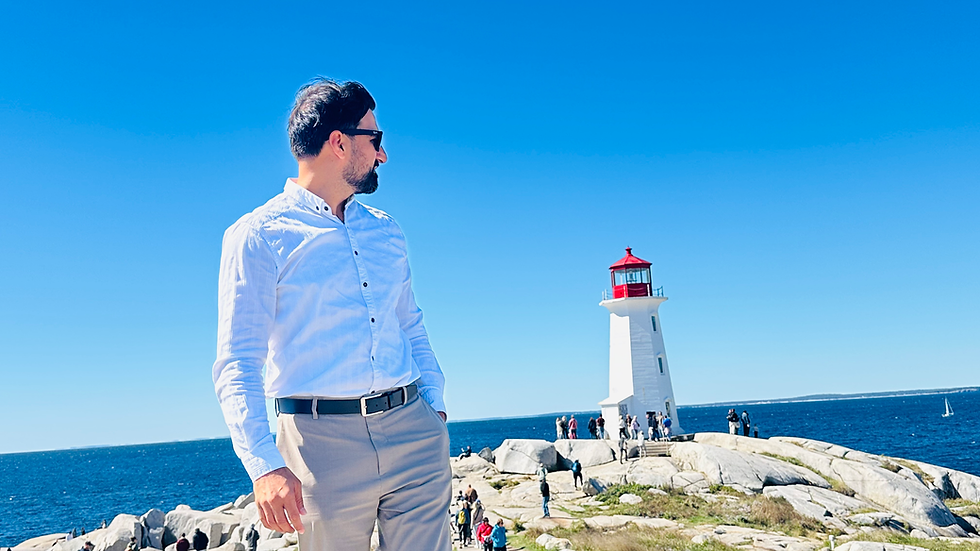
You have seen the photograph. The red-topped white lighthouse standing on pink granite at the edge of a grey Atlantic. A small fishing shack in the corner. Maybe a boat. The colours of the rocks — pinks and greys and silvers — that do not look quite real.

You have probably seen it on a calendar, in a tourism brochure, or on a screen saver. You may even have thought: " That cannot actually look like that in real life. Nobody's coastline looks that beautiful without filters. I am here to tell you: it does. And I have been there enough times to know.
My name is Asif Safi. I am the founder and primary guide of Safi Seaside Tours, based in Dartmouth, Nova Scotia. I have guided tours to Peggy's Cove in every season, in almost every weather condition, with visitors from dozens of countries speaking dozens of languages. This is the guide I wish every one of those visitors had read before arriving.
Where Exactly Is Peggy's Cove?
Peggy's Cove is a small unincorporated rural community on the eastern shore of St. Margarets Bay, on the Aspotogan Peninsula of Nova Scotia. It is located approximately 43 kilometres southwest of Halifax — a 45-minute drive under normal conditions.
The community has a permanent population of fewer than forty people, making it one of the smallest communities in Nova Scotia. It is also one of the most visited, receiving approximately half a million visitors per year.
The juxtaposition is worth understanding. You are visiting a genuine working fishing village — not a recreated tourist attraction — that happens to be built on some of the most dramatically beautiful coastal terrain in North America.
The History of Peggy's Cove Lighthouse
The lighthouse at Peggy's Cove — officially Peggy's Point Lighthouse — was first established in 1868, though the current structure dates from 1914. It is an octagonal wooden tower, approximately fifteen metres tall, painted white with a distinctive red upper section that has become one of the most recognised images in Canadian photography.
The lighthouse served as an active aid to navigation until 2009, when it was decommissioned as a functional lighthouse and transitioned to heritage status. Since 1979, the lower portion of the lighthouse has operated as a seasonal Canada Post office — the only lighthouse post office in the world.
This means visitors can mail postcards with a Peggy's Cove lighthouse cancellation stamp — a detail I always mention on tours, because the reaction is invariably delightful. People do not expect a post office inside a lighthouse.
The 'Peggy' of Peggy's Cove is believed by many historians to refer to Margaret, the sole survivor of a shipwreck in the cove in 1800. She settled in the community, married a local fisherman, and the community came to be associated with her name. The exact etymology is debated, but the romantic version of the story has proven durable.
The Geology: Why the Rocks Look the Way They Do
The geological feature that makes Peggy's Cove so visually distinctive is the massive exposure of the South Mountain Batholith — a body of granite that crystallized approximately 390 million years ago during the Devonian period, when two ancient continents collided to form the supercontinent Pangaea.
During the last ice age, approximately 10,000–20,000 years ago, the Laurentide Ice Sheet scraped the region nearly clean of soil and vegetation, leaving the granite exposed and polished. The result is the sweeping, treeless, rolling expanse of pink-grey rock that gives Peggy's Cove its otherworldly quality.
The rock is not just scenically extraordinary — it is also physically significant. The granite at Peggy's Cove is among the oldest exposed rock in Atlantic Canada. Standing on it is, quite literally, standing on the deep history of North America.
When I guide visitors across those rocks, I try to give them a sense of that scale. It changes the experience from 'that's a nice lighthouse' to 'I'm standing on something that was here before the dinosaurs.' The light is the same. The rocks are the same. The understanding is completely different.
What October at Peggy's Cove Actually Looks Like
On October 23, 2025, I brought Sarah, Kim, and their two friends to the lighthouse on a morning that was, by any honest measure, perfect.
Peggy's Cove Lighthouse, Nova Scotia Peggy's Cove Lighthouse, Nova Scotia Peggy's Cove Lighthouse, Nova Scotia Peggy's Cove Lighthouse, Nova Scotia Peggy's Cove Lighthouse, Nova Scotia Peggy's Cove Lighthouse, Nova Scotia
October in Nova Scotia has a quality that I find difficult to describe to people who have not experienced it. The air is clean in a way that summer humidity prevents. The sky achieves a shade of blue that feels almost artificial. The light is lower and warmer than summer light, which means that the pink in the granite rocks comes forward in a way it does not in high summer.
And the crowds are thinner. Significantly thinner.
In July and August, Peggy's Cove receives its highest visitor numbers. The parking lot fills quickly. The path to the lighthouse is dense with people. The viewing spots are occupied. The experience is beautiful but contested.
In October, particularly on a weekday morning, the granite expanse can feel almost private. You can walk to the edge of the cliff — staying well within the designated safe zones, because the waves and the wet rock demand real respect — and have the Atlantic stretching before you with nobody else in the frame.
Sarah stood at the water's edge for a long moment without speaking. Sometimes, silence is the correct response to Peggy's Cove.
Safety Notice: The Black Rocks Are Dangerously Slippery |
Every year, visitors are swept from the rocks at Peggy's Cove by rogue waves. The black rocks at the water's edge — darker than the surrounding granite because they are wet — are where people get into danger. Stay on the light-coloured granite and behind the warning signs. I say this on every tour. Please take it seriously.
The Best Time of Year to Visit Peggy's Cove Lighthouse
May–June (Late Spring): Wildflowers in bloom, fewer crowds than summer, mild weather. The light is beautiful. Some days can be foggy, creating a dramatic atmosphere of its own.
July–August (Peak Summer): Longest days, warmest weather, highest crowds. Arrive before 9 AM or after 4 PM to avoid the peak hour rush. Still absolutely worth visiting.
September–October (Autumn): My personal favourite. Crisp air, extraordinary light, autumn colours in the surrounding hills, smaller crowds, and some of the best light conditions for photography of the entire year.
November–April (Winter/Early Spring): Quiet and dramatic. The lighthouse looks extraordinary in the snow. Storms in winter produce waves that are genuinely awe-inspiring — from a safe distance. Not all services are available; the post office, for example, is seasonal.
What to Wear and Bring to Peggy's Cove
Layers: The temperature at Peggy's Cove is consistently 3–5 degrees cooler than inland Halifax, due to the ocean breeze. Even on warm summer days, bring a jacket.
Flat, closed-toe shoes: The granite rocks are beautiful but uneven. Sandals, heels, and flip-flops are genuinely dangerous on the rock surface. Wear walking shoes or sneakers with some grip.
Camera or charged phone: You will take more photos here than you expect.
Cash for the post office: The lighthouse post office accepts cash only. Bring a few dollars for postcard stamps — a genuinely unique souvenir.
Sunglasses: The light reflecting off the granite and the ocean is intense.
How to Get to Peggy's Cove from Halifax
The Halifax waterfront is beautiful — but the true character of Nova Scotia lies beyond the city. Places like Peggy’s Cove Lighthouse, coastal villages, and historic landmarks are not within walking distance. Experiencing them requires planning — and the right way to travel. One of the most rewarding parts of a well-planned shore excursion is how natural the day feels. Instead of rushing between stops, you have the time to explore, take photos, and enjoy the scenery. Whether it’s standing on the granite rocks at Peggy’s Cove, breathing in the Atlantic air, or simply enjoying the quiet beauty of the coastline — these are the moments people remember.
Private guided tour (recommended): A guide picks you up from your hotel or the cruise terminal, drives the coastal route with running commentary, handles all parking and timing. From $137 CAD per person with Safi Seaside Tours.
Making the Most of Your Port Call
Most cruise passengers arriving in Halifax have just 5 to 8 hours before their ship departs. That may not sound like much—but with the right plan, it is more than enough to experience something unforgettable. After guiding hundreds of visitors across Nova Scotia, I’ve seen the difference. Some return to their ship with great photos and lasting memories; others leave feeling like they only scratched the surface.
Why Choose a Private Shore Excursion?
A private tour allows you to explore Nova Scotia at your own pace. Instead of following a rigid bus schedule, you use your time efficiently. With a smaller group setting, the experience is personal—you can spend extra minutes for the perfect photo or ask questions in a language you’re comfortable with. Our goal is to turn a short visit into a relaxed, well-paced experience.
Tour Details at a Glance
Duration: 4 hours round trip.
Pickup: Direct from your hotel, cruise terminal, or Airbnb.
Group Size: Maximum 6 passengers per vehicle (larger groups can be accommodated with multiple vehicles).
Refreshments: Light snack and a drink included.
Language: Available in English, French, Hindi, Pashto, Dari, Urdu, Punjabi, Farsi, and Russian.
Stops: Peggy’s Cove Lighthouse, scenic viewpoints, Fairview Lawn Cemetery, Citadel Hill, and the Maritime Museum area.
Price: $137 CAD per person (No hidden costs)
The Photo Every Visitor Wants — And How to Get It Right
The lighthouse perspective photo — where you appear to be pinching or holding the lighthouse between your fingers — is one of the most popular travel photos in Atlantic Canada. It requires specific positioning: roughly 15–20 metres from the lighthouse, at a slight angle, with the photographer crouching or lying on the granite to create the right visual relationship between the subject's hand and the distant lighthouse.
I know exactly where to stand and what angle to use. On October 23, I set Sarah and Kim's group up at the right spot and watched them spend fifteen minutes laughing their way through various versions of the pose. Holding it like a trophy. Pretending to tip it over. Standing next to it like cartoon characters.
The best photos of the day were not the technically perfect ones. They were the ones where the laughter got to them, and they forgot to pose.
After the Lighthouse: Where to Eat in Peggy's Cove
The most famous restaurant in the Peggy's Cove area is Sou'Wester Restaurant, which has been serving visitors since 1973. Gift shop attached, classic Nova Scotian seafood menu, and a view of the lighthouse from the dining room.
On Safi Seaside Tours, we include a full lobster roll or fish and chips in the tour price — the freshest, most honest expression of Nova Scotian coastal food culture. The lobster tanks at the restaurant are a highlight in themselves. I spend a few minutes explaining the lobster fishery, the seasonal rotations, the trap limits, and the specific relationship between the weather, the water temperature, and the sweetness of the meat.
It turns a meal into an education. The best kind — one where you are full at the end.
Conclusion: Some Places Deserve the Stories Behind Them
Peggy's Cove lighthouse in Nova Scotia is one of the most photographed subjects in Canada. Millions of those photographs exist. Millions of people have stood at the edge of the Atlantic, looked at the red-topped lighthouse on the pink granite, and been genuinely moved.
What I hope this guide gives you is not just the practical information to visit — though it has that too — but the conviction that Peggy's Cove deserves more than a quick stop.
It deserves the walk across the granite with someone who can tell you that you are standing on 390-million-year-old rock. It deserves the conversation over a lobster roll about what it means to make a living from the sea. It deserves the kind of time that makes a photograph into a memory and a memory into a story.
Here’s a simple way to make the most of your time in Halifax:
• Morning: Pickup from the cruise terminal and scenic coastal drive
• Mid-morning: Explore Peggy’s Cove Lighthouse and the surrounding area
• Midday: Light snack and refreshment
• Early afternoon: Halifax highlights on return, including historic sites and viewpoints
• Return: Drop-off at the cruise terminal with time to spare
A private shore excursion allows you to use your limited time more efficiently and comfortably.
With a small group setting, the experience becomes more personal, flexible, and relaxed. You can spend more time where it matters, ask questions freely, and enjoy the journey at your own pace.
The focus is simple: quality over quantity, and experience over schedule.
Booking Section
Plan for the Best Experience. Halifax cruise season runs from May through October, with peak demand in the summer months. To secure your preferred date, it is recommended to book in advance.
You can reserve your tour directly through Safi Seaside Tours, with flexible scheduling and clear communication before your arrival.
Six hours may seem short — but the right six hours can stay with you for years.
Standing by the Atlantic, visiting iconic landmarks, and experiencing Nova Scotia beyond the city — this is what transforms a stop into a memory.
Your time in Halifax is limited. Make it count.
What This Improved Version Does:
• Removes repetition
• Keeps everything clean, premium, and easy to read
• Avoids any risky comparisons
• Focuses on experience + emotion + clarity
• Gently pushes toward booking without sounding aggressive
Come with that intention, and Peggy's Cove will not disappoint you.
— Asif Safi, Guide & Founder, Safi Seaside Tours


Comments