
'How Do We Know You're Any Good?' — What the Best Halifax Tour Guides Know That the Brochures Never Tell You


The honest guide to finding the best Halifax tour guide — and why the right person changes everything about your Nova Scotia visit
It is a fair question. A really fair question.
You are handing over your free time — possibly a significant portion of your travel budget — to a stranger in a new city. You have found them online, read some reviews, maybe seen some photos. But how do you actually know, before you step into their vehicle, whether this is going to be a transformative experience or a politely endured disappointment?
I have been that stranger for fifteen years. I have had guests who were deeply sceptical before the tour started and left as advocates. I have also spoken to visitors who had bad experiences with other guides and arrived defensive, braced for another letdown.
This post is my honest answer to the question of how to find the best Halifax tour guide — not because I am touting my own services, but because I genuinely believe that the quality of a guide determines the quality of a travel experience more than almost any other factor.
What Happened on October 23, 2025
I start with a story, because stories are how trust is established in tourism. Numbers and credentials are useful. Stories are how you decide whether someone actually knows what they are talking about.
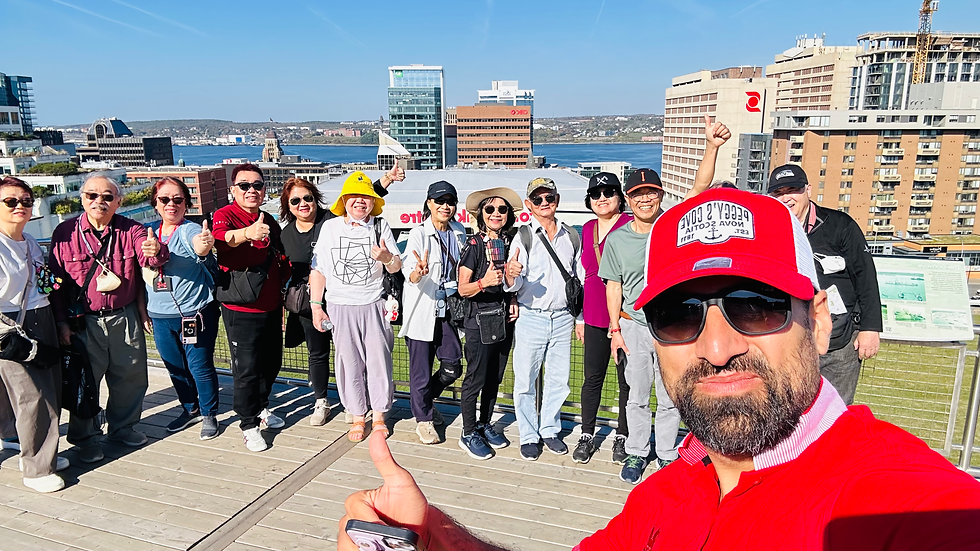
On October 23, 2025, I picked up Sarah, Kim, and their two friends from the Halifax cruise terminal. They were polite, friendly, and — I could tell — in that particular state of cautious optimism that experienced travellers carry when they have booked a tour from someone they found online.
I noticed two things in the first five minutes of the drive. First, one of their friends spoke limited English. Second, Sarah was asking very specific questions — about the geology of the coastline, about the economic history of the fishing industry, about the specific differences between how Nova Scotia lobster is harvested compared to Maine lobster.
These were not tourist questions. These were the questions of someone who had done genuine research and wanted to go deeper than the standard tour commentary.
I answered in two languages simultaneously — English for Sarah and Kim, another language for their friend — and went as deep as the questions demanded. We talked about glacial geology, the history of the Atlantic fishery, the economics of lobster licensing, and the specific architectural history of the fishing stages we passed along the coastal highway.
By the time we reached Peggy's Cove, forty-five minutes later, the group had relaxed completely. Not because I had been charming or entertaining. Because they could tell that the person driving them actually knew things.
That is the foundation of everything.
The 7 Things That Separate a Good Halifax Tour Guide from a Great One
1. Depth of Knowledge (Not Just Width)
Most tour guides know facts. The lighthouse was built in 1914. The population of Peggy's Cove is under forty. Lunenburg was founded in 1753.
The best guides know the story behind the facts. Why was the lighthouse built in 1914 and not 1890? (Because the original wooden structure was destroyed.) Why does Peggy's Cove have so few permanent residents? (Because the community resisted the kind of infrastructure development that would have enabled growth, choosing to remain a fishing village.) Why was Lunenburg the first organized British settlement outside Halifax? (Because the British Crown wanted Protestant settlers to counterbalance the French Acadian population.)
The depth is what makes commentary feel like a conversation rather than a Wikipedia summary.
2. The Ability to Read the Room
Different groups want different things. A retired couple on a photography holiday has different priorities from a family with young children. A group of history enthusiasts has different needs from a group of food and wine travellers.
The best guides adapt. Not just in what they say, but in how they structure time. When Sarah and Kim's group was clearly in love with the lighthouse, we stayed longer than scheduled. When another group I guided had a child who was getting tired and hungry, we moved the meal forward and condensed the outdoor time.
Flexibility is not a luxury feature. It is the baseline of professional guiding.
3. Multilingual Capability
Nova Scotia receives visitors from every part of the world. A guide who only speaks English is a guide who can only serve a portion of the market — and, more importantly, can only offer part of the experience to visitors who are more comfortable in other languages.
I speak English, French, Hindi, Pashto, Dari, Urdu, Punjabi, Farsi, and Russian. In a practical sense, this means that most of the international visitors who come through Halifax can have a tour in their first language.
In an experiential sense, it means that visitors do not spend the day translating — they spend it being present. That difference is profound.
4. Honest Pricing and Transparent Inclusions
The number of times I have met visitors who were surprised by hidden costs, unexpected add-ons, or tour descriptions that turned out to be misleading is depressing.
The best guide tells you exactly what is included before you book. No hidden charges. No 'meals not included' footnote after a tour that implied they were. No 'optional' experiences that turn out to be the entire point of the trip.
At Safi Seaside Tours: $137 CAD per person for the Peggy's Cove tour. That includes pickup, the tour, the meal, the drink, and the return. Those are the only costs. Full stop.
5. Safety Awareness Without Paranoia
Peggy's Cove kills people every year. Not because it is inherently dangerous, but because visitors misread the risks — they walk on wet black rocks near the ocean, or they ignore the warning signs, or they misjudge a wave.
A good guide mentions safety once, clearly and specifically, without turning it into a liability waiver recitation. I point out the black rocks. I explain why they are dangerous. I say clearly: stay on the light-coloured granite and behind the signs. Then I let people enjoy themselves.
I have never had an incident on a tour. I believe that is because I take safety seriously without making it the dominant energy of the experience.
6. Genuine Enthusiasm — Not Performance
There is a particular kind of tour guide enthusiasm that is exhausting. The relentless cheerfulness, the scripted jokes, the practiced gasps of admiration at the same viewpoints every tour.
And then there is the enthusiasm of someone who genuinely finds their subject matter interesting — who still gets something from watching a group of four people discover Peggy's Cove lighthouse for the first time, even after having made that drive hundreds of times.
I am still excited by the drive to Peggy's Cove. I still find the geology of those rocks genuinely fascinating. I still enjoy the conversations over lobster rolls about the history of the Atlantic fishery. That enthusiasm is not manufactured. It is why I do this work.
7. What Happens After the Tour
The day after I guided Sarah and Kim, I received a message from Sarah with photos and the words: 'We had so much fun! Thank you!'
She also told me that when I sent her the website link, she and Kim were in the middle of telling their fellow cruise passengers about the tour. Word of mouth, in real time, unsolicited.
That kind of outcome does not happen with guides who view their job as transactional. It happens when the visitor leaves feeling that someone genuinely cared about their experience — not just as a customer, but as a person who came a long way to see something beautiful and deserved to actually see it.
Questions to Ask Before You Book a Halifax Tour
How many people will be in the group? (If the answer is more than 8, it is not a private tour.)
Is the meal included, or is it an optional extra?
Do you speak [my language]?
Can we adjust the timing based on our cruise departure or other commitments?
What happens if the weather is bad? (A good guide has a contingency plan, not just a cancellation policy.)
Have you done this tour recently? (The best guides visit their destinations regularly — not just during season.)
Can I see recent photos from actual tours, not stock photography?
The answers to these questions will tell you more than any review platform rating.
How to Book with Safi Seaside Tours
Visit safiseasidetours.com
Select your tour from Peggy's Cove, Lunenburg, the Combo, or a Custom Private Tour
Book online with a 50% refundable deposit
Receive a personal confirmation with all details, a direct phone number, and everything you need to prepare for your day
Questions before booking?
WhatsApp or call +1 (902) 402-7263.
Available Monday to Sunday, 7 AM to 10 PM.
Conclusion: The Guide Is the Tour
The lighthouse is the lighthouse. It looks the same from a group bus as it does from a private vehicle. The rocks are the same colour. The ocean sounds the same.
What changes is everything else — the understanding, the context, the conversation, the flexibility, the feeling of being a guest rather than a ticket.
The best Halifax tour guides know that they are not showing people places. They are helping people experience a province. The places are just where that experience happens.
Choose carefully. Ask the right questions. And when you find a guide who genuinely knows what they are talking about — who can shift languages mid-sentence, who knows the name of every cove along the coastal highway, who has already thought about your all-aboard time and planned the return accordingly — hold onto that booking.
It will be the part of the trip you tell people about.
— Asif Safi, Guide & Founder, Safi Seaside Tours


Comments